Picture Book
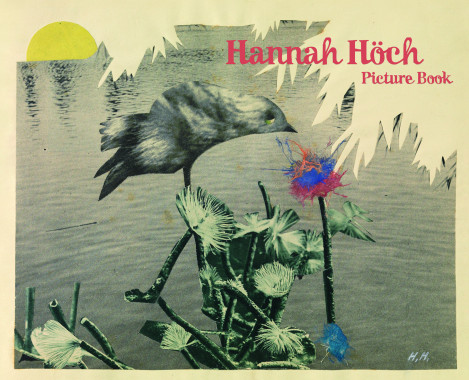
Hannah Höch’s Bilderbuch [Picture Book] from 1945 is now finally available in English, through the ingenious translation by Brian Currid.
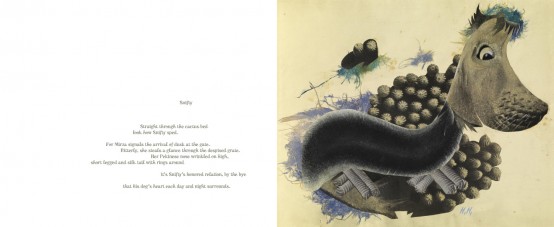
The Picture Book presents the fantastic adventures of Runfast, Dumblet, Snifty and Meyer 1, mythical creatures which seem like a dream in a zoological garden, surrounded by fairy tale flowers and plants. Yet, it is not only a wonderful book for children, but an important cultural and historic document, as it was created by Hannah Höch, the most important female artist of the Modernist period in Germany. It is designed through the Dadaistic principle of photomontage which Höch developed, together with Raoul Hausmann, in the early years of the 20th century.
Gunda Luyken writes in her essay about the book: "To counter the grey postwar years, Höch developed in 19 collages and accompanying texts a magical world populated by fantastic exotic plants and animals. People play no role here, apart from the baby emerging from one of the eggs that Madame Marklet has collected around her. ... Although Höch always spoke of her 'picture book', the texts are an essential part of the work. For each of the collages, the artist thought up brief, delicate rhymes that sketch out miniature stories and are reminiscent of the verses of Joachim Ringelnatz or Christian Morgenstern. She gave her impish creatures the oddest names—Loftylara, Brushflurlet, Unsatisfeedle and Runfast. Although Höch conjured up in images and words a fantastic world, it is one not free of human weaknesses like dissatisfaction or disagreement, as represented, for example, by the couple Longfringes. All the same, the book exudes a cheerfulness and light-heartedness that the philosopher and writer Salomon Friedländer also attributed to the artist herself: 'Basically, you are a fabulous and wonderful girl—and whoever doesn’t get you must be a dull and totally impossible guy. And who does understand you? A child, just like you.'"
The book also contains the original German verses by Hannah Höch.
The German version of the Bilderbuch is available here.
Nicole Rudick on ThoughtCatalogue.com (23 August 2010):
[…] One other illustrated children’s book that came out of the Dada group wasn’t actually created until after World War II. Höch put together her Bilderbuch, or picture book, a photomontaged zoological garden accompanied by a series of sly, silly poems, in 1945. Unfortunately, Bilderbuch wouldn’t be published in its entirety until 1985, six years after Höch’s death, and then only in a limited edition of 200. Now, Berlin publishing house the Green Box has rescued this unique volume from out-of-print obscurity with a lovely facsimile edition that reproduces the poems in English translation (courtesy of Berlin-based scholar Brian Currid).
[…] The hybrid animals are every bit the hobbyhorse—syntheses of diverse objects that, united as a single image, receive new life in the reader’s imagination. In one case, Höch uses only slightly trimmed photographs of Komondor dogs, whose long coats resemble the white, twisted cords of a mop. Their appellation, Longfringes, mimics their alien, ropy appearance, but in the context of the book, the animals become something else altogether. The transformation is aided by Höch’s brief nursery rhymes; some offer light morals, others are gently subversive, but all elicit a delightful naivete.
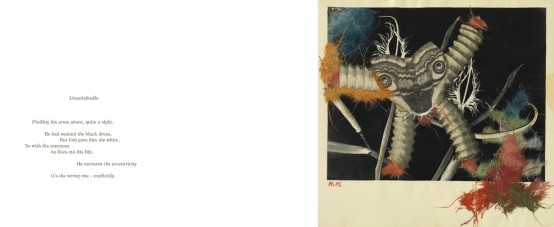
Unsatisfeedle
Flailing his arms about, quite a sight,
He had wanted the black dress
But God gave him the white.
So with his sourpuss
he lives out his life.
He nurtures the eccentricity
it’s the wrong one — explicitly.
Words and images are everywhere joined in tomfoolery. Most of the poems’ characters have collaged names: Unsatisfeedle, the Runfast (and her 1,000 runfastlets), Shellkeglet, the Brushflurlet, the Snipplensnapplewings. In “Meyer I,” Höch tweaks rumor and aquarium so that they rhyme; the resulting rumourium and aquorium share consonants and vowels, each becoming a hybrid of the other. The image on the facing page likewise adopts a quirky syntactic fusion, in which something is not quite right: Roughly half of a cat’s face, open-mouthed, is cut to look like an angel fish, swimming among jade-green plant life on his way, the poem announces, “to the office.” The story of the Tailchamois begets a kind of nonsense: “With their long tails / they sweep away the snow and rime / while on their mountain climbs. / For they want the winter / to toddle off a sprinter.”
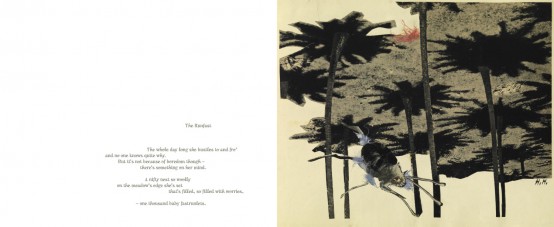
Of his fellow Dadaists, Hans Arp once asserted, “We do not wish to imitate nature, we do not wish to reproduce. We want to produce. We want to produce the way a plant produces its fruit, not depict. We want to produce directly, not indirectly.” None of Höch’s creatures can be said to follow the dictates of nature, though sometimes they beget a world that appears to be a topsy-turvy version of our own. In the image accompaniment to “The Runfast,” the titular creature, an insect with a human eye and blue-purple tufts of fur, skitters under what look like a group of flowers with starburst-shaped blooms but are in fact the trunks and shadows of palm trees turned upside down. The irrationality in Picture Book isn’t the chaotic, anarchist brand that defines much Dada art, but rather an innocent version, eschewing machine aesthetics for an organic sort. Höch’s children’s book also doesn’t offend the sensibilities, a primary aim of the movement, but it does unleash them—and perhaps that is the more radical of the two.
Dawn Ades writes in ARTFORUM (December 2011):
In her 1945 children’s book Bilderbuch, recently published for the first time in English as Picture Book (Green Box), Hannah Höch again took up the medium of photomontage that had in her hands become one of Berlin Dada’s most powerful, aggressive, streetwise tools. In Weimar Germany it was the modern world of jazz, record players, film, fashion plates, crowds, race cars, and machines that provided the grist for her satiric, feminist montages, which juxtaposed a sequence of women’s eyes and fragments of faces to create a male profile, or showed the head of her friend the poet and artist Raoul Hausmann, mouth stretched as he recites a phonetic poem, being extruded from metal armature. In Picture Book, by contrast, it is nature that is reinvented: Plants, flowers, fruits, fabrics, hair, feathers, and unnameable bits of creatures (none obviously human except one wailing baby) are magically cut to pieces and recombined to make a new bestiary. Höch has added multicolored fibers to the cut-and-pasted photographs, which not only supplies the decorative effect she desired but also gives a density and depth to these wonderful, subtle, comic images. Built up of multiple fragments, the creatures may be imaginary but are made highly expressive through the precision of the cut edge that creates a posture, the placing of an eye, the transformation of the original material. Each picture is accompanied by a short poem in which Höch plays Dada-like linguistic games (brilliantly translated here by Brian Currid). Dada’s ludic strategies had often claimed the irreverent freedom of childhood, aiming at what Höch’s fellow Dadaist Hans Arp called a “natural and unreasonable order.” Here, the poems nail the distinct character of each fantastic new animal or bird, which have comic invented names such as die Schnippeldebonchen (the Snipplesnapplewings) and der Unzufriedel (the Unsatisfeedle). Part of the intimate delight of reading this book lies in first catching the curious nature of the creature—wily, smug, dissatisfied, lonely, pompous, prissy, delicate—and then reading the corresponding poem. So of the serpent Boa Perlina, who is clearly perfidious, with a snaky body made of pearls or perhaps frog spawn, Höch writes: “Trust her not, I say / the beauty in pearl gray.” The unclassifiable Unsatisfeedle, whose large eyes are pasted on a head of butterfly-like patterns, limbs cut from paper lanterns that look like centipedes, “wanted the black dress, / But God gave him the white.”
