A Brief History of Curating New Media Art

This book of interviews tracks the work of curators in the field of new media art in order to consider the massive changes and developments over a relatively short period of time. They are also a celebration of the ten years that the online resource for curators of new media art, CRUMB, has been publishing interviews and other research. The curators featured in this book range across the contemporary arts. They have been working away, not in the centre or the periphery, but in the nodes of this networked field of new media art.

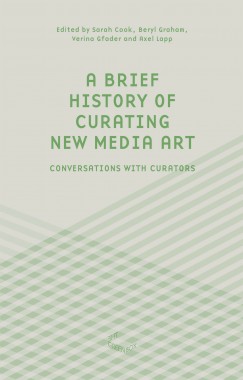
A Brief History of Curating New Media Art - Conversations with Curators was edited by Sarah Cook, Beryl Graham, verina Gfader and Axel Lapp. It contains interviews with Sarah Cook & Beryl Graham; Peter Weibel; Barbara London; Christiane Paul; Larry Rinder; Kathy Rae Huffman & Julie Lazar; Benjamin Weil; Liliane Schneiter, Yves Mettler & Anne-Julie Raccoursier; Liane Davison; Nathalie Anglès & Sebastien Sanz de Santamaria; Matthew Higgs; Magdalena Sawon & Tamas Banovich; Steve Dietz; Rudolf Frieling.
A second book, A Brief History of Working with New Media Art - Conversations with artists, was published at the same time.

Reviews: 

Janine Armin writes in The New York Times of 15 June 2010:

The Creative Landscape of Independent Curators

LONDON — You may not have heard of the “precarious age,” but for freelance curators in Europe, the term sums up today’s job market.

In the late 1990s, a strong sampling of their predecessors were snapped up by museums full time and presented atypical ideas to unsuspecting visitors. In 1999, the freelancer Nicolaus Schafhausen took the reins at the Kunstverein Frankfurt, and in 2002 he presented a group show on the nebulous topic of nonplaces. And the former freelancers Nicolas Bourriaud and Jérôme Sans themselves founded Palais de Tokyo, the Parisian contemporary art center, in 1999 and conceived an exhibition that related deejaying to art.

In the last few years, however, long-term employment prospects have become more limited. Large institutions tend to hire just one or two outside curators to help out on specific exhibitions. So freelance curators are weathering the economic downturn by creating highly innovative exhibitions for a series of institutions, both large and small.

The verdict is still out on whether the results are more radical than those of their predecessors. According to Jens Hoffmann, director of the Wattis Institute for Contemporary Arts at the California College of the Arts in San Francisco, in the 1990s “freelance curating was considered something that had fresh ideas and was in some way revolutionary.” He added, “All those ideas are now completely part of the mainstream system, so that you don’t actually need freelance curators anymore in order to make radical statements.”

Yet directors at many institutions argue that independent curators’ specialized voices are still crucial. In fact, for its 10th anniversary this year, the Tate Modern in London decided to highlight their contributions. In mid-May, the “No Soul for Sale” show, initiated by the artist Maurizio Cattelan and the freelance curators Cecilia Alemani and Massimiliano Gioni, filled Turbine Hall with nearly 70 independent art spaces and curatorial groups for one weekend.

Museums are also, to some extent, still employing freelancers. “We are still hiring freelance curators if their expertise is needed,” said Petra Joos, deputy director for museum activities at the Guggenheim Museum Bilbao, which enlisted the independent curator Ghislaine Wood for the “Surreal Things” exhibition in 2008 and Martin Sonnabend for the “Dürer” show in 2007.

At the Moderna Museet in Sweden, Magnus Jensner, director of the Museet’s new Malmo outpost, said that the “Time and Place” exhibition, which ran from September 2008 to January 2009, provided an overview of “certain regions that had a great creative surge during a certain period” not represented in their collection. For depth of detail he hired the freelancers Luca Massimo Barbero and Paulo Venancio Filho for the Milan-Turin and Rio de Janeiro portions, respectively.

In London, the contemporary art gallery The Serpentine is even more soliciting. Among other things, the institution has freelancers curate annual group shows. “I think it’s very important for institutions to bring in outside curators,” said Hans Ulrich Obrist, the co-director of exhibitions and programs and director of international projects. He applauded the “completely new view” offered by the German designer Konstantin Grcic, who structured the museum’s first-ever design show, which ended in February.

...

It used to be that “one curator would draw a master plan of the exhibition,” said Mr. Obrist. “I’ve always thought it’s more interesting to create a more polyphonic situation where you have several curatorial voices within an exhibition.” In 2008, The Serpentine invited RAQs Media, an artist/curator collective from New Delhi, to curate a show within the “Indian Highway” exhibition, which as a whole changes as it travels. “Each time the show goes somewhere, we invite another guest curator to add another layer,” Mr. Obrist said.Clearly, independent curating is a hotbed of change, which makes it all the more necessary to nail down its history. “There are a lot of past models of experimental curating which will be very useful to helping us invent the future,” said Mr. Hoffmann, the Wattis Institute director.

Two recent books — “A Brief History of Curating” (2009), comprising Mr. Obrist’s interviews with the 20th century’s leading curators, and “A Brief History of Curating New Media Art” (2010), edited by Sarah Cook, Beryl Graham, Verina Gfader and Axel Lapp — provide important insights. But as Mr. Obrist noted, what happens next “depends so much on what will be the future of art.”